Evaluating the NFT Landing Page PSD Template for Metaverse Projects
In the rapidly evolving landscape of digital assets and blockchain technology, the visual presentation of a project often determines its initial reception. For creators, developers, and agencies looking to launch Non-Fungible Token (NFT) collections, the NFT Landing Page PSD Template serves as a critical foundational tool. This resource is not merely a collection of graphics; it is a structured design framework intended to streamline the development of high-converting minting pages. By providing pre-designed layouts for essential components such as NFT collections, roadmaps, team member profiles, and FAQs, this template addresses the specific functional requirements of Web 3.0 projects.
Understanding the utility of an NFT Minting Collection Landing Page PSD Template requires looking beyond aesthetics to the operational needs of a launch. The primary value proposition lies in its comprehensiveness. A successful NFT drop relies on building trust and clarity within a short window of time. Potential investors need to understand the utility of the asset, the credibility of the team, and the technical process of acquisition. This template integrates these elements into a cohesive visual narrative, reducing the friction between user interest and wallet connection.
Core Components and Functional Design
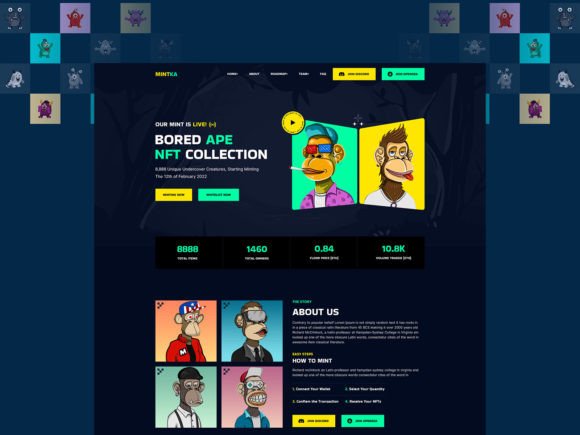
The architecture of this template is designed to mirror the user journey of a typical NFT investor. It begins with a strong visual hook, typically showcasing the artwork or the metaverse environment associated with the collection. However, the true strength of the NFT Landing Page PSD Template is found in its specialized sections. The inclusion of a dedicated roadmap section allows projects to visualize their long-term vision, which is crucial for establishing legitimacy in a market often scrutinized for short-term speculation.
Furthermore, the template addresses the technical barrier to entry inherent in Web 3.0 interactions. One of its most significant features is the design for a Web 3.0 wallet connection popup. Supporting major wallets such as MetaMask, Fortmatic, and Coinbase Wallet, this element is pre-designed to ensure users understand how to connect their digital assets securely. For designers and developers, having these interaction states mapped out in PSD format simplifies the transition from static design to functional code, ensuring that the user interface (UI) remains intuitive during the critical minting phase.
Strategic Benefits for Project Launches
For teams operating under tight deadlines, the adoption of a pre-built template offers substantial efficiency gains. Developing a custom landing page from scratch involves extensive wireframing, UI design, and iterative feedback loops. The NFT Minting Collection Landing Page PSD Template condenses this timeline, allowing teams to focus resources on smart contract development, community building, and marketing strategies. The modern design and carefully selected color palettes provide a professional baseline that can be customized to align with specific brand identities without sacrificing structural integrity.
Another benefit is the standardization of information hierarchy. In the NFT space, information overload can lead to decision paralysis. This template organizes content logically, guiding the visitor from discovery to action. The inclusion of team member sections helps humanize the project, addressing a common concern among investors regarding anonymous or unverified creators. By presenting these details in a polished, consistent format, the template aids in establishing the credibility necessary for a successful mint.
Considerations and Tradeoffs
While the convenience of a template is evident, it is important to consider the tradeoffs. The primary limitation of any PSD template is its static nature. While the NFT Landing Page PSD Template provides excellent visual guides, it does not include the front-end code (HTML/CSS/JavaScript) or back-end integration required for a live site. Teams must possess the technical capability to convert these designs into a responsive, functional website. For non-technical founders, this may necessitate hiring a developer, which adds to the overall project cost.
Additionally, reliance on a template can lead to visual homogeneity if not properly customized. Since multiple projects may utilize similar templates, there is a risk that a landing page could look generic. To mitigate this, designers must leverage the flexibility of the PSD files to alter color schemes, typography, and layout structures significantly. The "beautiful color palettes" mentioned in the template description are starting points, not final decisions. Successful projects will use these assets as a canvas for unique branding rather than a rigid constraint.
Ideal Use Cases
This template is particularly well-suited for mid-sized NFT projects and metaverse initiatives that require a professional online presence but lack the budget for a bespoke agency-level design. It is also an excellent choice for design agencies that manage multiple client launches, as it provides a reliable, tested structure that can be rapidly adapted for different brands. Startups entering the Web 3.0 space will find the included FAQ and roadmap sections invaluable, as these are often overlooked in early-stage design but are critical for user education.
Moreover, the template’s focus on wallet connectivity makes it ideal for projects prioritizing ease of access. If the primary goal is to maximize minting conversions by reducing technical friction, the pre-designed wallet popup interfaces offer a proven user experience pattern. This is especially relevant for audiences who may be new to cryptocurrency and require clear, visual cues to navigate the connection process safely.
When to Consider Alternatives
Despite its advantages, the NFT Minting Collection Landing Page PSD Template may not be the optimal solution for every scenario. High-profile projects with unique artistic directions or complex interactive requirements may find the template restrictive. In such cases, a custom-designed experience that integrates dynamic 3D elements or gamified interactions might be more appropriate. Similarly, projects that do not require a traditional minting process—such as those focusing solely on secondary market trading or community governance—might benefit more from a dashboard-oriented design rather than a landing page focused on initial acquisition.
Furthermore, if a team lacks access to skilled UI/UX designers or front-end developers, a no-code website builder with integrated Web 3.0 plugins might be a more practical alternative. While these platforms may offer less design flexibility than a PSD template, they reduce the technical burden of implementation. The decision ultimately depends on the team’s internal capabilities and the specific strategic goals of the NFT launch.
Making the Right Decision
Selecting the right design resource involves balancing speed, cost, and uniqueness. The NFT Landing Page PSD Template represents a middle ground, offering professional quality and structural completeness without the high cost of custom design. For those evaluating this option, it is essential to assess the team’s ability to customize the assets effectively. The template provides the tools, but the final outcome depends on the creativity and technical execution applied to it.
Ultimately, the value of this template lies in its ability to reduce uncertainty. By providing a clear blueprint for essential sections like roadmaps, team bios, and wallet connections, it allows creators to focus on the substance of their project. Whether launching a metaverse initiative or a digital art collection, having a solid visual foundation can significantly impact user trust and engagement. For those seeking a efficient, professional, and comprehensive starting point, this template aligns well with the demands of modern NFT project launches.